Wehrheim Photography
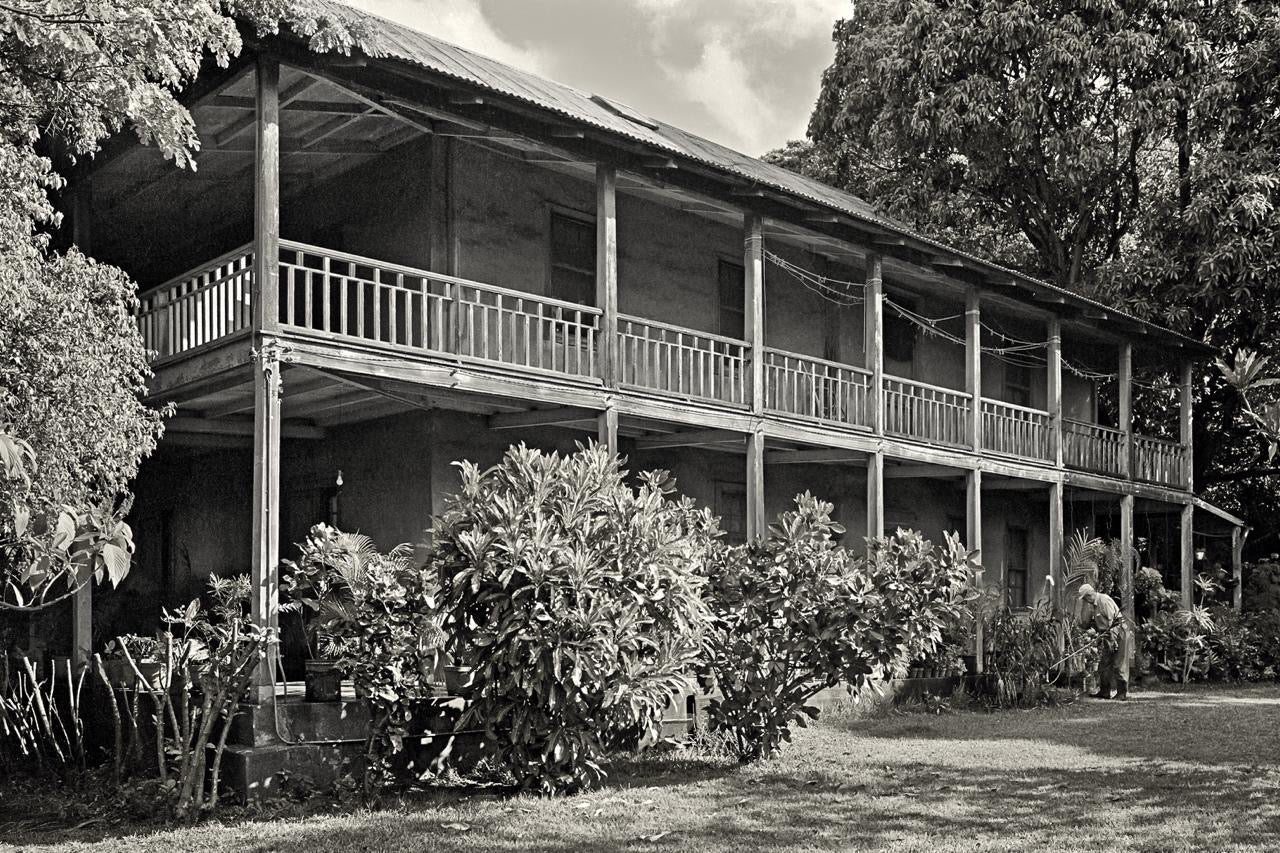
Gulick-Rowell House, 1976
Gulick-Rowell House, 1976
Couldn't load pickup availability
Share
In this image, Otto Wramp waters his plants outside the lanai of the Gulick-Rowell House in Waimea. Born in Kekaha in 1897, Otto spent his career with the Waimea Sugar Company and the County of Kauai. In 1930, Otto moved into the Gulick-Rowell House, and stayed there until his death in 1984. For most of those years, his wife Lily and their two daughters, Phoebe and Ethel, lived with him.
The Gulick-Rowell House is the oldest home on Kauai and the second-oldest in Hawai'i, admired for its architecture and historic value. What caught my eye were the clotheslines on the upstairs lanai and the plants circling the first floor. I’ve always believed a historic building's story isn’t complete without remembering the people who lived there – the human touch. So when Mr. Wramp stepped outside in his rubber boots to water his plants, it felt like the record was complete.
Missionary Peter Gulick built the home in 1829. Originally from New Jersey, Gulick and his wife, Fanny, arrived in Honolulu in 1828, as part of the third company of missionaries sent by the American Board of Commissioners for Foreign Missions to Hawai'i. The Gulicks were assigned to the mission station at Waimea, where they joined the efforts of Reverends Samuel and Elizabeth Whitney to expand evangelical and educational work among the Native Hawaiians.
The governor of Kauai, Kaikiōʻewa, provided a temporary Hawaiian-style thatch-and-pole house, but the couple soon began constructing a more permanent home using coral limestone quarried from nearby reefs by Hawaiian laborers for the foundation, floor, and walls, along with lumber from the upland forests nearby. Gulick's early duties at Waimea focused on preaching the Christian gospel in outdoor meetings and simple chapels, often starting with basic translations to convey core doctrines. He also introduced the Hawaiian alphabet developed by earlier missionaries to enable Native Hawaiians to read scripture and other educational materials. In addition to their evangelical work, the Gulicks supported the establishment of Hawai'i's first commercial sugar plantation at Kōloa. He later contributed to the establishment of schools on O’ahu and Moloka’i, including the foundation of Punahou School in 1841.
After the Gulicks vacated the house in 1835 when they transferred to the missionary station in Kōloa, the house remained empty until 1846 when it was occupied by Reverend George Rowell and his wife Malvina, who came to Kauai from New Hampshire in 1843. Rowell was an accomplished carpenter who built two churches in Waimea during his term there, as well as expanding the family home, adding lumber shipped in from the West Coast. The Rowells remained in the home until George's death in 1884. After that the home was occupied by various townspeople, including the postmaster, the sheriff, who reportedly used the basement as a jail, and various schoolteachers and church members.
The house has been on the National and State Historic Register since 1972 and unoccupied since 2003. In 2006, the Historic Hawaii Foundation: placed Gulick-Rowell House on the list of Hawaii’s Most Endangered Historic Places. In 2025, restoration of the home began under the auspices of the nonprofit community organization Hale Puna and leading restoration architect, Glenn Mason.